
Digital Workspace Meets AI Agents: What Our 2026 Market Research Found
25 Aug 2026 • 8 min read
Digital Workspace Meets AI Agents: What Our 2026 Market Research Found
We spend most of our time on this blog in the weeds of Omnissa Workspace ONE and Scalefusion configuration. This post is a step back: a market-level look at what's happening to the digital workspace category as a whole, based on research we pulled together this month from Gartner, IDC, PwC, WRITER and the vendors themselves.
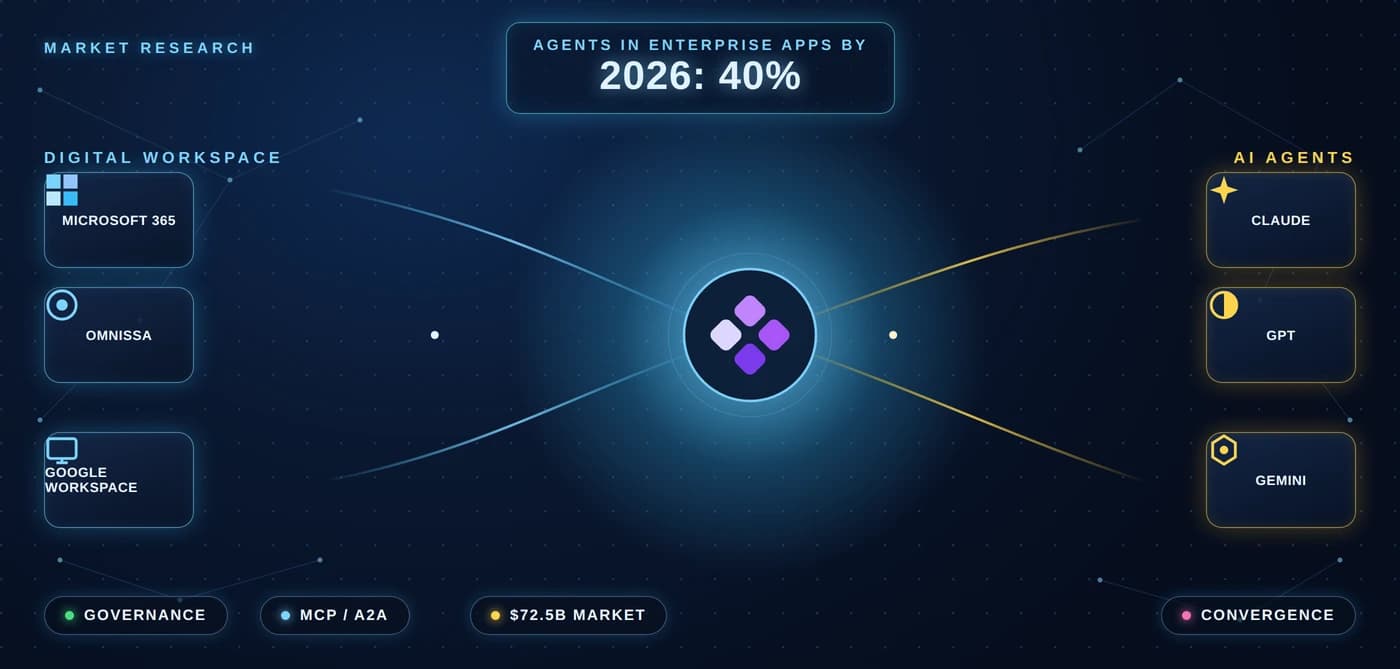
The short version: the digital workspace platforms you already manage — Microsoft 365, Omnissa, Google Workspace — are turning into the governance layer for AI agents, at the same time the AI labs behind Claude, GPT and Gemini are pushing agents directly into the tools your users already have open. Both sides are converging on the same unmanaged gap: agents running with nobody controlling their access. For anyone doing endpoint and identity management, that gap is going to land on your desk whether you asked for it or not.
The market, in numbers
The digital workplace market was worth an estimated $59.4 billion in 2025 and is projected to reach $72.5 billion in 2026, on its way to $323.5 billion by 2033 — a 23.8% CAGR. Hybrid work and continued cloud migration explain most of that, but AI is now called out as a distinct accelerant: intelligent search, automated workflow processing, and predictive analytics layered onto platforms that used to just sell seats for email and file storage.
The agent-specific numbers are sharper. Gartner expects task-specific AI agents to be embedded in 40% of enterprise applications by the end of 2026 — up from under 5% in 2025. IDC's 2027 forecast is similar in scale: 40%+ of enterprise apps carrying agentic capability, a tenfold increase in agent adoption among the Global 2000, and a thousandfold increase in the API call volume those agents generate. Whatever your current MDM or UEM roadmap looks like, agent traffic is about to become a real line item on it.
What's actually driving — and blocking — AI budgets
Here's the part that should give every IT leader pause: the confidence gap is bigger than the adoption gap. PwC finds 88% of executives plan to increase AI budgets in the next year. WRITER's 2,400-leader survey finds only 29% see significant ROI from generative AI today, and 48% call their AI investment a "massive disappointment." Fifty-nine percent of companies are already spending over $1 million a year on it.
Where it does work, the payoff is real: PwC reports 66% of companies deploying agents see productivity gains, 57% see cost savings, 55% see faster decisions, and 54% see better customer experience. But the more interesting finding is what's actually holding the rest back. It isn't the model. PwC's own framing: "technology isn't the barrier, mindsets are." Cybersecurity concerns and implementation cost tie for the top blocker at 34% each — well ahead of workflow integration, change management, or user adoption.
WRITER's numbers explain why security tops that list. Sixty-seven percent of organisations believe they've already had a data breach traced to an unapproved AI tool. Thirty-five percent say they couldn't immediately shut down a rogue agent if they found one running. Gartner's own projection follows directly from that: over 40% of agentic AI projects will be cancelled by the end of 2027, for cost overruns, unclear value, and — the one that should sound familiar to anyone who's managed an unmanaged BYOD fleet — governance failure.
Translate all of that into one sentence and it reads like a request we already know how to fulfil: give us AI we can govern, that pays for itself, and that won't quietly leak data or run up an uncapped bill.
Two camps, converging from opposite directions
That's the demand signal. The supply side is where it gets interesting for anyone in our line of work, because two very different kinds of vendor are arriving at the same answer.
The workspace incumbents are becoming AI control planes. Microsoft's 2026 stack now runs five layers deep: Copilot as the in-app assistant, Copilot Studio as the low-code builder, a Cowork Agent delegation layer for full multi-step autonomous execution (currently in Frontier Preview — and, notably, running on Claude rather than a Microsoft model), and Agent 365, launched 1 May 2026, as the actual governance and control plane: Entra Agent IDs, shadow-agent discovery, lifecycle management. It doesn't build agents. It polices them.
Omnissa's own 2026 State of Digital Workspace research is the clearest evidence of why that governance layer had to exist. Copilot sits on 97.5% of enterprise mobile devices under formal IT governance — but ChatGPT is running on 91% of iOS devices and Gemini on 61% of Android devices largely outside that governance. Omnissa calls it the "shadow perimeter," and it's repositioning Unified Endpoint Management as "Autonomous Endpoint Management" on the strength of that gap — a single control plane meant to support "humans and agents" equally, which is exactly the kind of device- and identity-level observability argument we make to clients already. Google, for its part, is betting on owning the whole stack — model, cloud, silicon and a 3-billion-user workspace — with Gemini Enterprise and its Agent2Agent (A2A) protocol, now in production across 150 organisations.
The AI labs, meanwhile, are pushing the other way. Anthropic's Claude Cowork is pitched as needing no platform team and no custom engineering — deployable to any team directly. OpenAI's Workspace Agents plug straight into Slack, Salesforce, Google Drive, Notion and Microsoft's own apps, positioned as "permissioned coworkers" that don't wait around for a Copilot Studio build cycle. Both labs are, in effect, routing around the incumbent's front door.
What's stopping this from turning into three incompatible walled gardens is protocol neutrality. Model Context Protocol (MCP) — originally Anthropic's — was donated to the Agentic AI Foundation under the Linux Foundation in December 2025 and now has client-side support across Claude, ChatGPT, Gemini, Microsoft Copilot and GitHub Copilot, with roughly 2,000 registered servers covering everything from Slack to Salesforce. It collapses what used to be an N×M integration problem into N+M. A2A handles the adjacent problem — agent-to-agent handoffs across vendor boundaries. Between the two, a buyer's real decision is shifting from "which AI ecosystem do we join" to "which governance and identity layer do we trust, and which model do we plug into it for a given job."
Why this matters for the fleets we manage
None of this is abstract for us. Every one of those governance mechanisms — Entra Agent ID, Omnissa's "govern AI" pitch, the account-permission-schedule model Microsoft is only now formalising in Agent 365 — is answering the same question we already answer for human identities every day: who is this account, what is it allowed to touch, and can we prove it when asked. The difference is that an AI agent doesn't take a lunch break, doesn't forget its password, and can generate a week's worth of policy violations in an afternoon if nobody's watching the account.
If your organisation is already fielding requests to "just turn on Copilot" or field questions about ungoverned ChatGPT and Gemini usage on managed devices, that's the shadow perimeter showing up in your own environment. The fix isn't a different opinion about which AI lab has the best model — it's the same discipline we already apply to device and identity management, extended to cover a new class of account that happens not to be human.
Where to start: treat every AI agent your organisation adopts — Copilot, a Copilot Studio build, a Claude Cowork deployment, a ChatGPT Workspace Agent — as an identity that needs the same enrolment, least-privilege, and audit-trail discipline as any user account. If you can't currently answer "which agents have access to what, and can we revoke it in one action," that's the gap worth closing first, before the next budget cycle adds three more agents to the pile.
Sources and further reading
- Digital Workplace Market Size & Trends Report, 2026-2033 — Grand View Research
- Omnissa State of Digital Workspace 2026 — press release
- Omnissa named a Leader in the 2026 Gartner Magic Quadrant for DEX
- Microsoft 365 AI Agents: The Complete Guide (Copilot, Copilot Studio, Agent 365) — Context Studios
- Recreate Copilot Studio agents with Microsoft Entra Agent ID — Microsoft Learn
- Building AI agents for the enterprise — Claude by Anthropic
- Google Cloud Next 2026: AI agents, A2A protocol, Workspace Studio — TheNextWeb
- OpenAI unveils Workspace Agents — VentureBeat
- Enterprise AI adoption in 2026: Why 79% face challenges despite high investment — WRITER
- PwC's AI Agent Survey
- AI Agent Adoption 2026: What the Data Shows (Gartner, IDC) — Joget
- Everything your team needs to know about MCP in 2026 — WorkOS
Workspace Consultants are independent MDM consultants specialising in Omnissa Workspace ONE and Scalefusion deployments across the UK, Germany, Switzerland, and Austria. We are not affiliated with Microsoft, Omnissa, Google, Anthropic, or OpenAI — we give objective, implementation-level advice.